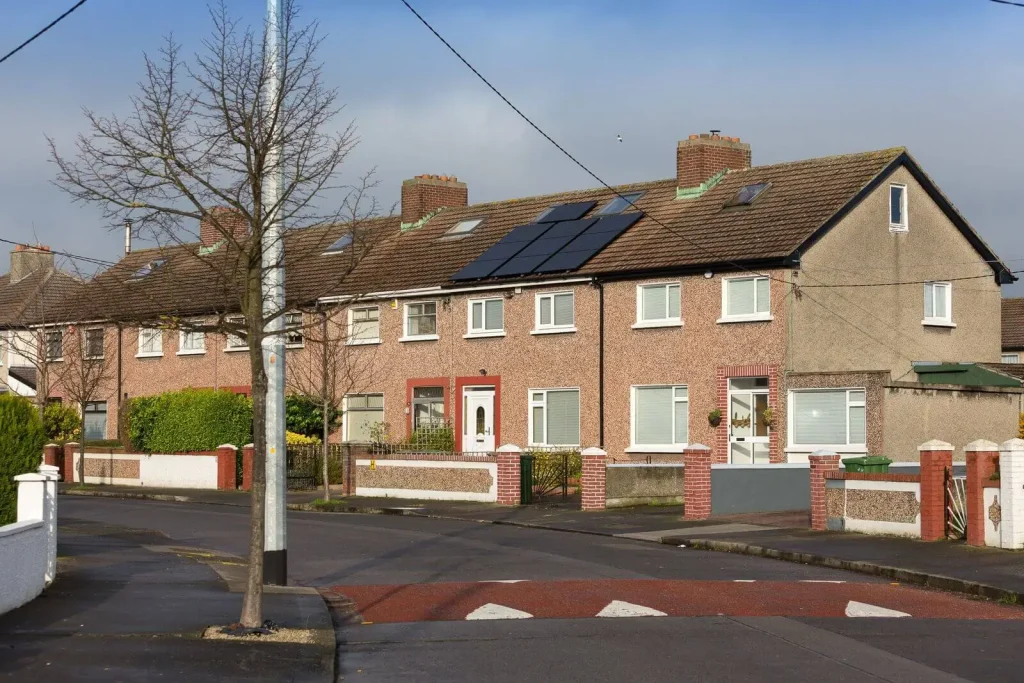

SEAI business grants for solar now pay an effective 45% of eligible costs, up from roughly 23%, with a maximum grant of €325,200 for systems up to 1 MWp.
The higher rate only applies to new applications made inside a nine-month window that closes on 6 July 2027. There is no grandfathering, so any business sitting on an older letter of offer stays on the old rate unless it cancels and reapplies.
For an Irish business, farm, school or community building, that is the single biggest change to commercial solar funding in years. The rest of this guide covers what the grant is worth at each system size, who qualifies, what the money does not cover, and the lead times that decide whether a project lands inside the window at all.
What the Enhanced SEAI Solar Grant Is Worth for a Business
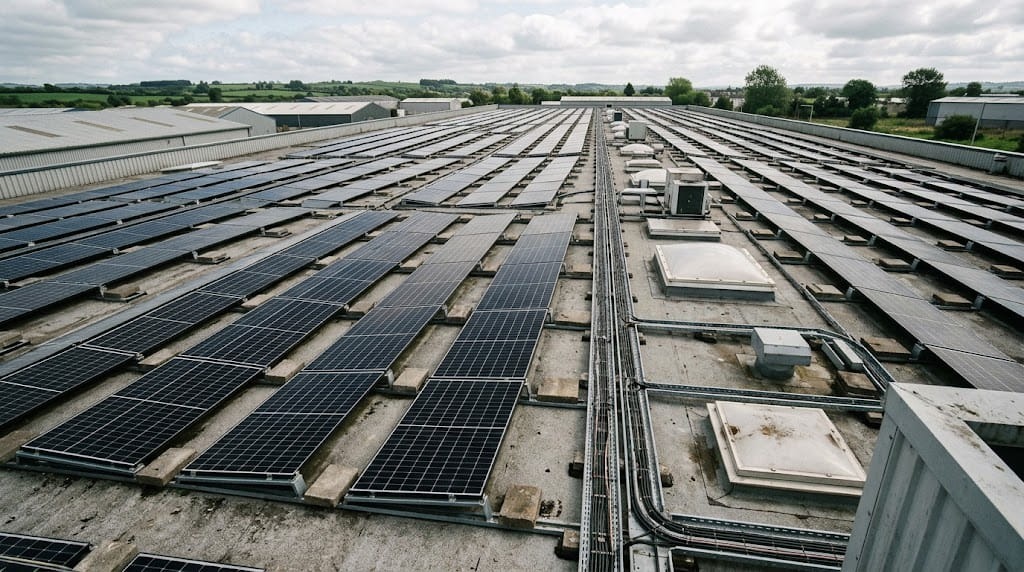
Grant values start at €1,800 for a 1 kWp system and rise to a ceiling of €325,200, with SEAI paying the lower of your band value or 45% of the invoiced cost. Systems from 1 kWp up to 1,000 kWp (1 MWp) can be funded.
| Solar PV system size | Grant value |
| 1 kWp | €1,800 |
| 2 kWp | €3,600 |
| 3 kWp | €4,200 |
| 4 kWp to 6 kWp | €4,800 |
| 7 kWp to 20 kWp | €600 per kWp |
| 21 kWp to 200 kWp | €400 per kWp |
| 201 kWp to 1,000 kWp | €300 per kWp |
Source: SEAI’s Non-Domestic Microgen Grant page, which also carries a grant value calculator for a specific system size.
The 45% figure acts as a cap, not a bonus. When the works are finished you submit an invoice, and SEAI pays whichever is smaller, the band value on your application summary or 45% of what you actually paid. A keenly priced quote can therefore pull the grant below the headline band.
What those bands look like against real project budgets is set out in our guide to commercial solar panel costs in Ireland, which covers typical system sizes by building type and the payback that follows.
How Long the 45% Rate Lasts and Why the Deadline Bites Early
The enhanced rate runs for a nine-month application window ending 6 July 2027, and it covers new applications only. Existing applications will not be uplifted, because grandfathering is not permitted under State aid rules. Anyone who has already started works on an older offer cannot go back for more.
That deadline is earlier in practice than it looks on paper, because several steps have to happen in sequence.
- A formal contract with a registered company has to be agreed before you apply.
- Grant offers are valid for eight months from the date of the letter of offer.
- Your installer must apply to ESB Networks before installing, and that process takes at least four weeks (20 working days).
- Works cannot start until the letter of offer lands. Starting early disqualifies the application.
So the real task is getting quotes, picking a contractor and submitting the application well inside the window, rather than aiming at July itself.
Who Qualifies for SEAI Business Grants for Solar
The grant is open to businesses, the agricultural sector, public sector bodies, schools, community centres and non-profit societies. There is no ranking system and no tranche deadline, so a qualifying applicant who applies correctly gets an offer.
A few conditions decide whether an application goes through cleanly:
- The installation must be carried out by a registered SEAI Non-Domestic Microgen (Solar PV) company.
- Grant offers must be in hand before any works begin.
- Grants above €10,000 in a calendar year require a Tax Clearance Certificate, which businesses apply for through Revenue’s eTax Clearance system on ROS before payment can issue.
- All documentation must be uploaded by the installer before payment is processed, with 4 to 6 weeks allowed after that.
Farms are eligible too, and the 45% rate has become the practical route for growers and dairy farmers who lost out on solar support under TAMS. The trade-offs specific to agricultural sites, from shed orientation to three-phase supply, are covered in our post on what Irish farmers must know before installing PV.
What the 45% Business Solar Grant Does Not Cover
Battery storage is not an eligible cost under the Non-Domestic Microgen Grant. The new €600 battery grant announced alongside it is a domestic measure, so a business adding storage to a commercial array funds that element itself.
Two other limits are worth knowing before you build a budget.
- The grant covers solar PV generation equipment and the works to install it, not wider electrical upgrades driven by site conditions.
- Systems larger than 1 MWp can still apply, but the grant stops at the €325,200 ceiling.
Separately, the Accelerated Capital Allowance for energy efficient equipment is a tax measure rather than a grant, and it is worth putting the ACA and Triple E register in front of your accountant when the capital case is being built.
How to Apply for the Grant Before the Window Closes
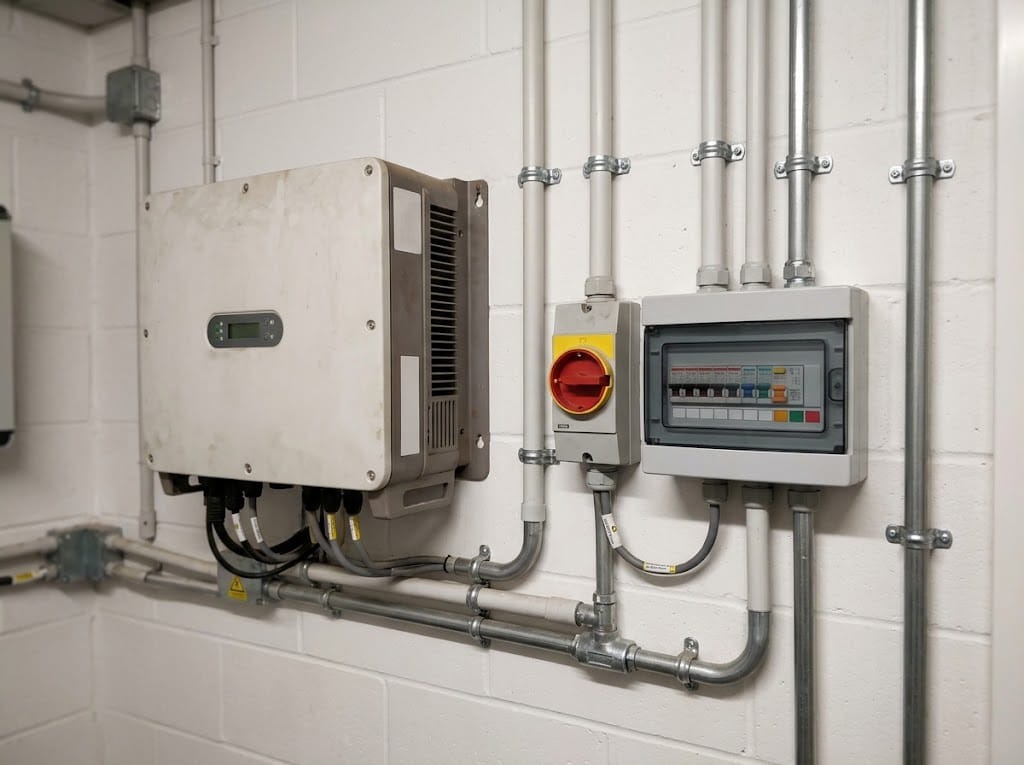
- Get quotes from several registered Non-Domestic Microgen (Solar PV) companies and agree a formal contract with your chosen one.
- Apply online to SEAI and wait for the letter of offer. No works before that point.
- Your installer applies to ESB Networks for the connection, allowing at least four weeks.
- Installation goes ahead once the connection is approved.
- Your installer uploads the completion documentation to SEAI, ideally within a few days of finishing.
- SEAI processes payment, typically 4 to 6 weeks after all documents are received, longer if an inspection is required.
Choosing an Installer for a Commercial Solar Project
Only an SEAI-registered Non-Domestic Microgen company can deliver a grant-funded commercial system, so the register is the starting point rather than a general search. Beyond registration, the thing that separates contractors on larger sites is whether they have actually handled projects at that scale and dealt with ESB Networks applications repeatedly.
That is where track record earns its keep. The team here has been installing in Ireland since 2012, with over 12,000 systems completed, and has delivered work for Sisk, Pfizer, Lidl, Bord na Móna, Cairns, Carrol Estates and Neville Homes.
For a business weighing a 50 kWp or 200 kWp array, the practical questions are narrower than the brochure version:
- Who prepares and submits the ESB Networks application, and how quickly?
- Who manages the SEAI paperwork from offer to declaration of works?
- How is roof structure, cable routing and switchgear capacity surveyed before a price is given?
- What happens to the programme if the connection approval runs long?
Those answers decide whether a project clears the 6 July 2027 deadline.
Getting a Commercial Solar Project Moving in Time
The window is finite and the sequence in front of it is fixed, so the businesses that benefit are the ones that start quoting now rather than in spring. A survey, a firm contract and a submitted application are the three things standing between a site and an offer letter.
Send through your roof details and a recent electricity bill and request a commercial solar quote to get a sized system, a grant value and an application timeline back in writing.
 How much is the SEAI commercial solar grant in 2027?